

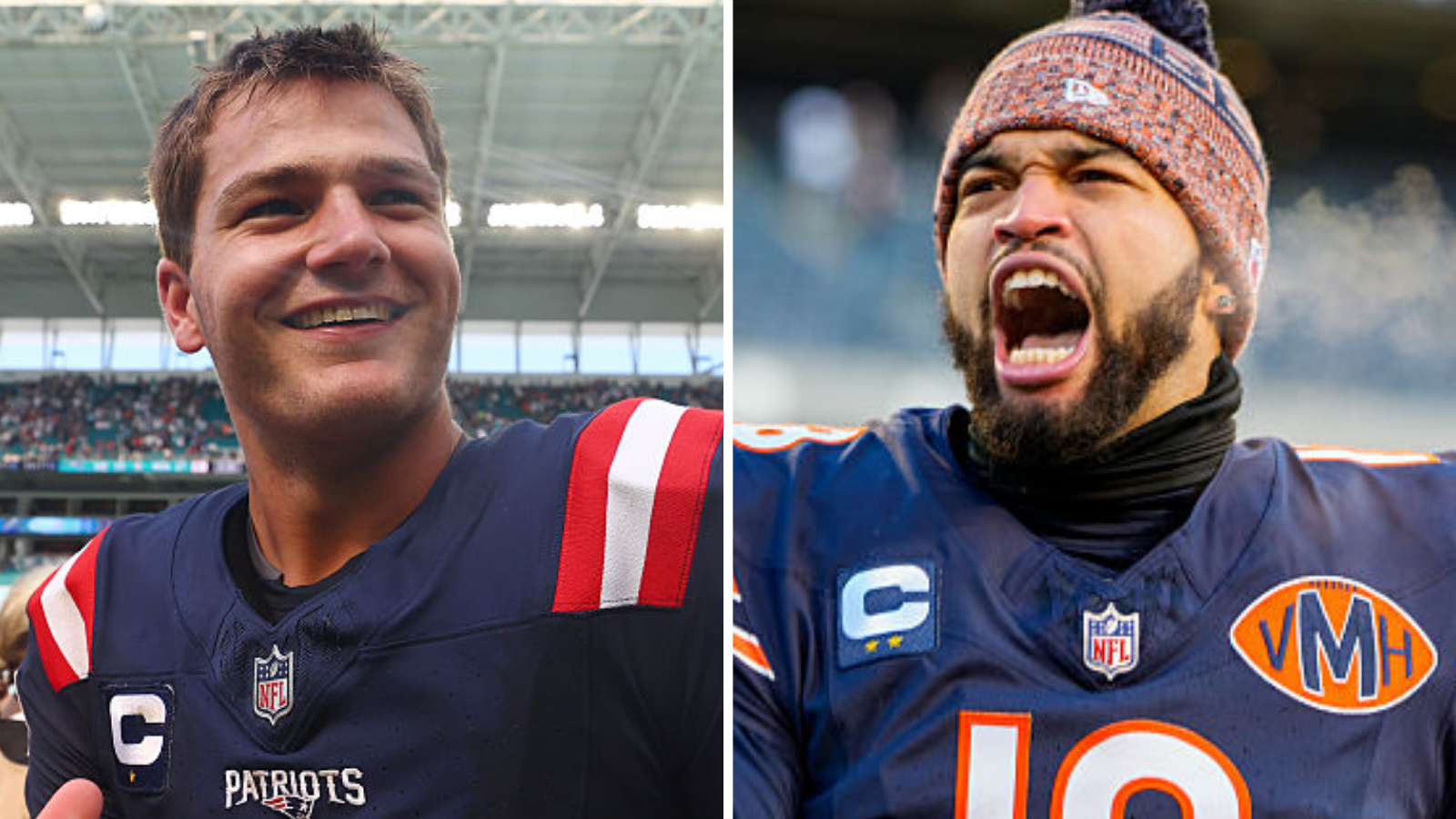
New England's Drake Maye (left) and Chicago's Caleb Williams were top-three draft picks in 2024
One dominant era has ended, veteran leaders have struggled, and unexpected teams have risen to become championship contenders.
As noted by experienced analyst Cris Collinsworth, "this is the most unusual year I can remember in the NFL."
The playoff field is set with 14 teams, marking the first time in over a decade that the Kansas City Chiefs are not participating.
Last year's champions, the Philadelphia Eagles, have been less formidable, and teams like the Buffalo Bills, tipped for success early on, have not delivered.
However, in a rare statistical twist, 11 of the 14 playoff teams secured at least 11 victories during the regular season, a feat achieved only twice in the past 35 years.
An unprecedented five clubs reached the playoffs following seasons with 11 or more defeats, including New England and Chicago, who each went from last place to first in their divisions.
"Requesting a single favorite is difficult," Collinsworth continued, "as a case can be made for virtually every team."
"It's going to be amazing to watch these young quarterbacks go at it because I don't know what they will do. This is when legends begin to be built."
How Do the NFL Playoffs Function?
Fourteen teams enter the postseason, split evenly with seven representatives from both the AFC and NFC.
A twelve-game, single-elimination bracket over three weeks keeps AFC and NFC teams apart, culminating in the conference champions facing off in Super Bowl 60.
Superior seeds host their games, and the top-ranked teams, Denver and Seattle, skip the first playoff round, known as Wildcard Weekend.
Denver and Seattle start their playoff runs in the Divisional Round. The AFC and NFC champions, decided in the Conference Championship games, will play for the Lombardi Trophy at Levi's Stadium.
A rematch of the 2014 Super Bowl between Seattle and Denver is possible, though Denver later rebounded to win Super Bowl 50 at the same venue in 2016.
Why the AFC Championship Race Is Completely Open
The postseason will proceed without Kansas City's Patrick Mahomes, a playoff constant until now, marking a significant shift.
Moreover, the championship game will feature neither Mahomes nor the Bengals' Joe Burrow, a first for the Super Bowl in several years.
Powerhouse franchises like Kansas City, Cincinnati, and Baltimore all missed the playoffs, removing the AFC's customary frontrunners and clearing the stage.
The path to the AFC title is therefore unobstructed, allowing rising talents including Bo Nix of Denver and New England's Drake Maye to pursue playoff immortality.
The AFC champion has come from a very small group since 2016, and the players from those winning teams have all since moved on.
Top seed Denver has minimal recent playoff experience, and besides the Broncos and Patriots, Pittsburgh is the only other AFC playoff team with a Super Bowl appearance since 1995.
However, two veteran AFC quarterbacks with extensive pedigrees—Aaron Rodgers of Pittsburgh and Buffalo's Josh Allen—could use their experience to challenge the newcomers.
Identifying the Frontrunners for the Super Bowl and MVP
The NFC boasts more recent playoff pedigree, with Philadelphia, Los Angeles, or San Francisco appearing in seven of the last eight Super Bowls.
The Rams and 49ers have felt postseason pressure for a while, competing intensely with Seattle in what is considered the NFL's toughest division, the NFC West.
Seattle won the NFC West with 14 victories, carrying a seven-game win streak into the playoffs following critical late-season wins over its division foes.
As the NFC's top seed, the Seahawks are now narrow favorites for the Super Bowl, while Rams quarterback Matthew Stafford is the player most likely to win MVP honors.
Despite his Super Bowl ring from 2022, Stafford has yet to be named MVP and is positioned just ahead of New England's Drake Maye in the award race.
Under the guidance of new coach Mike Vrabel, Maye has flourished, instrumental in New England's stunning reversal from 4-13 a year ago to a 14-3 powerhouse.
In Chicago, quarterback Caleb Williams has also prospered with a new head coach, Ben Johnson, transforming the Bears into an 11-win team and the NFC's second seed.
Schedule for Wildcard Weekend
All times are in GMT
Saturday, 10 January
The Rams travel to face the Carolina Panthers (21:30)
Chicago Bears welcome the Green Bay Packers (01:00 Sunday)
Sunday, 11 January
Buffalo Bills @ Jacksonville Jaguars (18:00)
Philadelphia Eagles face the San Francisco 49ers (21:30)
The Chargers visit the New England Patriots (01:00 Monday)
Monday, 12 January
Houston Texans @ Pittsburgh Steelers (01:00 Tuesday)
Major Plotlines Heading into Wildcard Weekend
The Rams begin Wildcard Weekend in Carolina, a team that made history by reaching the playoffs with a losing 8-9 record after stumbling to the NFC South title.
Los Angeles must play away, but quarterback Matthew Stafford led the league in passing yards and touchdowns, with receiver Puka Nacua posting a career-high 1,715 receiving yards.
Green Bay's momentum was stalled by late-season injuries, but they will have quarterback Jordan Love back for just the third playoff game in the NFL's oldest rivalry.
Winning the NFC North was an achievement for Chicago, but the Bears now aim to prevent a three-game losing streak from ending their playoff run abruptly.
In the NFC's other wildcard game, a banged-up San Francisco squad travels to face Philadelphia, the defending champions who rested players after locking up the NFC East.
Buffalo's Josh Allen, the reigning MVP, hopes to finally reach the Super Bowl, but the Bills must travel to Jacksonville, a team riding an eight-game winning streak.
{New England aims to avoid an upset at home against the Los Angeles Chargers, whose quarterback Justin Herbert seeks his first playoff win in his sixth season.|The Patriots hope to defend their home field against the Chargers, as LA's quarterback Justin Herbert looks for his inaugural postseason victory in year six.|At home, New England tries to stave off the Chargers, with Justin Herbert attempting to secure his first career playoff


